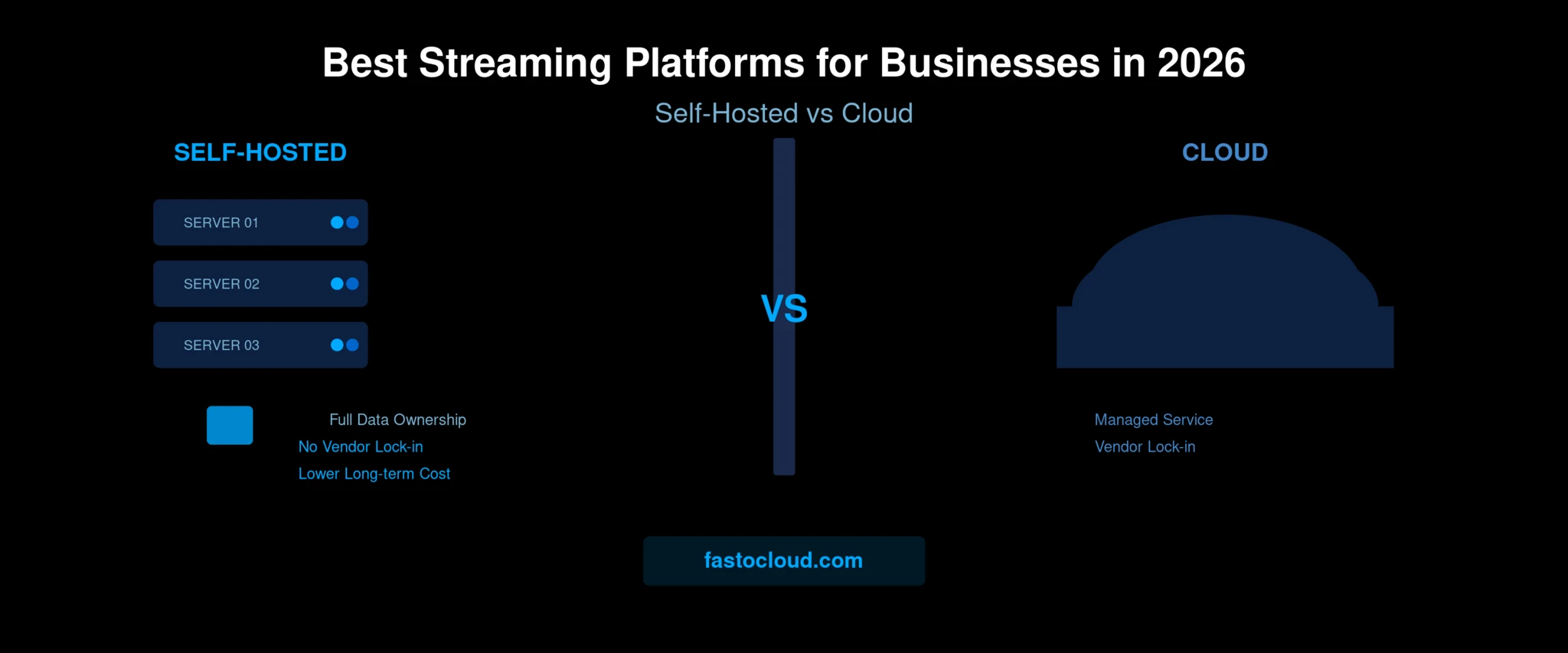
Why the Delivery Model Matters More Than Ever
The video streaming market is no longer just a consumer phenomenon. In 2026, businesses across every sector. From telecoms and broadcasters to hotels, retailers, and training providers. Operate their own streaming platforms. And the most consequential decision they face is not which codec to use or which CDN to subscribe to: it is whether to run their platform on self-hosted infrastructure or to rely on a managed cloud streaming service.
Both approaches have matured significantly. Cloud platforms offer speed-to-market and hands-off operations. Self-hosted platforms offer control, cost efficiency at scale, and data sovereignty. The right answer depends on your business size, growth trajectory, regulatory environment, and how much of the stack you want to own. This article breaks down the trade-offs so you can make an informed decision. And shows how FastoCloud provides a compelling self-hosted alternative for businesses that have outgrown generic cloud solutions.
Cloud Streaming Platforms: The Trade-offs
Cloud streaming services gained mainstream adoption for good reasons. They eliminate the need for dedicated hardware, reduce the operational burden on engineering teams, and allow a business to go live quickly with minimal upfront investment. For early-stage projects or businesses testing a new streaming vertical, this is genuinely valuable.
However, cloud platforms carry real costs that become apparent at scale:
- Bandwidth and egress fees - Cloud providers bill per gigabyte delivered. As your viewer base grows, these costs scale linearly and can dwarf the platform fee itself.
- Vendor lock-in - Proprietary APIs, encoding pipelines, and DRM integrations make migration expensive. Once you are deep into a cloud provider's ecosystem, switching costs are substantial.
- Limited customization - Managed platforms constrain what you can configure. Custom transcoding profiles, non-standard delivery topologies, and advanced monetization logic often require costly professional services engagements or are simply not possible.
- Data residency and compliance risk - Many industries. Healthcare, finance, government media. Require content and subscriber data to remain within specific jurisdictions. Cloud platforms may not offer the granular control needed to satisfy these requirements.
- Opaque pricing at scale - Pricing calculators rarely reflect real-world usage patterns. Businesses regularly discover that their actual cloud bill is two to three times higher than their initial estimate once live traffic begins.
Self-Hosted Streaming: Full Control, Full Ownership
Self-hosted streaming means deploying your media infrastructure on servers you control. Whether in a colocation facility, a private data center, or a dedicated cloud instance where you own the operating system and software stack. The key distinction from managed cloud services is that you are not paying a per-stream or per-gigabyte premium to a platform vendor.
The advantages are substantial for businesses operating at meaningful scale:
- Predictable, hardware-based costs - You pay for servers and bandwidth, not for platform access. At sufficient volume, this is dramatically cheaper than consumption-based cloud pricing.
- No vendor lock-in - Your encoding configuration, subscriber database, and content library are entirely under your control. You can migrate, extend, or replace components without external permission.
- Full data sovereignty - Content and subscriber data never leaves your infrastructure. This is a hard requirement for regulated industries and operators serving privacy-sensitive markets.
- Unlimited customization - You can implement any transcoding profile, integrate any payment gateway, build any subscriber experience, and extend the platform with custom logic.
- Competitive advantage through differentiation - When you control the full stack, you can ship features and integrations that commodity cloud platforms will never prioritize for your specific use case.
The trade-off is operational responsibility. Self-hosted platforms require capable engineering to deploy, monitor, and maintain. But in 2026, purpose-built self-hosted solutions like FastoCloud dramatically reduce this burden by packaging the entire streaming stack into a single, well-documented platform.
Head-to-Head: Self-Hosted vs Cloud for Business
- Cost at scale - Self-hosted wins. Cloud costs grow with every viewer-hour; hardware costs are largely fixed once provisioned.
- Speed to launch - Cloud wins for the very first deployment. Self-hosted solutions with good tooling close this gap quickly.
- Customization depth - Self-hosted wins. Cloud platforms offer configuration; self-hosted offers control.
- Data ownership - Self-hosted wins. Your data stays on your infrastructure, always.
- Compliance - Self-hosted wins for regulated industries where data residency is mandatory.
- Operational overhead - Cloud wins for teams without streaming infrastructure expertise. Purpose-built self-hosted platforms like FastoCloud substantially reduce this advantage.
- Scalability - Both models scale, but in different ways. Cloud scales on demand with no pre-planning; self-hosted scales by adding nodes, which requires capacity planning but avoids per-stream cost spikes.
When Self-Hosted Makes Financial Sense
The crossover point. Where self-hosted becomes cheaper than managed cloud. Depends on your traffic volume and content type. A useful rule of thumb: if you are consistently delivering more than 1 TB of video per day, or if you are running more than 50 concurrent live streams, the economics of self-hosted infrastructure typically become compelling. At 10 TB/day, the cost advantage is usually decisive.
Beyond pure economics, self-hosted is the right choice when:
- Your business operates in a regulated sector with strict data residency requirements.
- Your product roadmap requires deep platform customization that cloud vendors cannot support.
- You are building a white-label service where your brand. Not the platform vendor's. Must be the only identity your customers see.
- You need to integrate streaming tightly with existing on-premise systems (ERP, CRM, billing, CCTV infrastructure).
FastoCloud: The Complete Self-Hosted Streaming Stack
For businesses that have decided self-hosted is the right model, the practical question becomes: which platform do you deploy? Building a streaming stack from scratch. Assembling FFmpeg, nginx, HLS packagers, subscriber management, DRM, EPG, and client apps. Takes months and requires deep expertise in each component. FastoCloud solves this by providing the entire stack in a single, integrated platform.
The FastoCloud Media Server handles hardware-accelerated transcoding (Nvidia GPU and Intel QSV), multi-protocol delivery (HLS, DASH, RTMP, SRT, WebRTC), internal CDN and load balancing, catchup/DVR, and EPG management. The CrocOTT middleware layer adds subscriber management, billing integration, content delivery, analytics, and a white-label admin panel. Everything you need to run a commercial OTT or IPTV service. White-label player apps for Android, iOS, Android TV, Apple TV, Samsung Smart TV, LG Smart TV, Fire TV, and web complete the stack.
The Media Server starts at $25/month (Community edition) with PRO and PRO ML tiers available for operators who need WebRTC streaming, AI-powered video analytics, or custom neural model deployment. CrocOTT middleware is priced at $0.20 per active subscriber per month - a model that aligns platform cost directly with your revenue growth.
Because every component is self-hosted on Linux, you retain full ownership of your infrastructure, your subscriber data, and your content. There are no egress fees, no per-stream charges, and no dependency on a third-party platform's uptime or pricing decisions.
Making the Right Choice
In 2026, the streaming platform decision is less about technology maturity. Both cloud and self-hosted options are technically capable. And more about business strategy. If speed to market and minimal operational commitment are paramount, managed cloud platforms serve that need. If data ownership, cost efficiency at scale, and deep customization are priorities, self-hosted is the superior model.
For businesses that are serious about streaming as a core product or revenue line, self-hosted infrastructure is increasingly the professional choice. FastoCloud makes that choice accessible without requiring a large in-house infrastructure team or months of integration work.
Ready to evaluate a self-hosted streaming platform for your business? Start a free trial or review pricing to see how FastoCloud fits your scale and requirements.
Blog FastoCloud