Free Live Streaming Platforms vs Paid: What Operators Need to Know in 2026
By Alex Topilski, Founder
YouTube Live processes over 500 hours of video uploaded to its platform every minute, yet an operator building a subscription IPTV service on it cannot collect a single subscriber email, enforce a geo-block, or deploy a custom-branded app. That gap between reach and control is the central problem with free streaming platforms for anyone running a commercial video service. This article maps that gap concretely - with real numbers - so operators can make an informed infrastructure decision in 2026.
What "Free" Actually Means for Streaming Operators
Consumer platforms like YouTube Live, Twitch, and Facebook Live are free in the sense that there is no monthly platform fee to start streaming. The actual cost is structured differently: these platforms monetize through advertising and revenue sharing rather than subscriptions. YouTube retains 45% of channel membership revenue. Twitch takes 50% of subscription income - a cut that stayed at 50% even for many partnered channels after contract renegotiations in 2023. Facebook Live generates ad revenue for Meta, not the streamer.
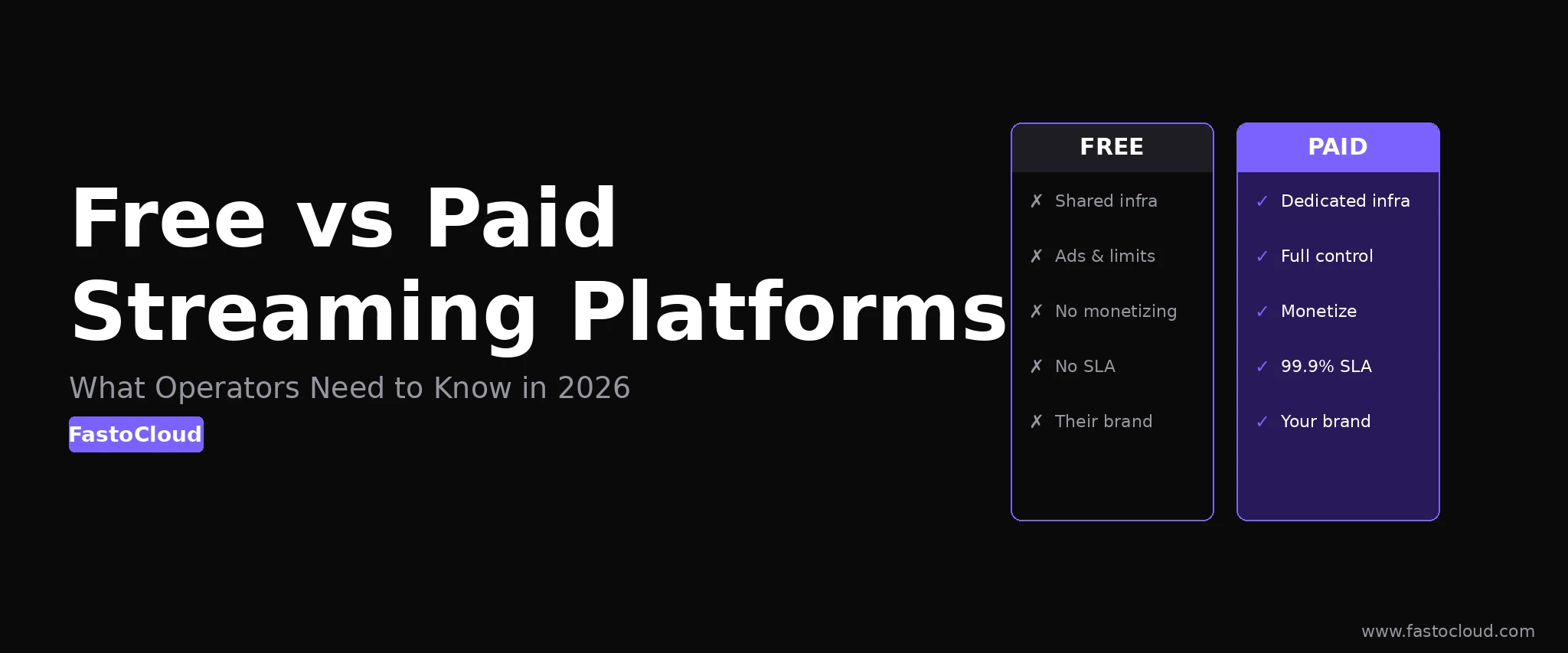
Beyond revenue share, free platforms impose structural constraints that make them unsuitable for commercial IPTV or OTT operations. Subscriber data - email addresses, viewing histories, payment details - belongs to the platform, not the operator. There is no white-label option: your service runs under YouTube's branding, YouTube's player, and YouTube's terms of service. There is no subscriber management layer: you cannot set device limits per account, enforce geo-restrictions based on content licensing agreements, or integrate with an Electronic Program Guide. For a personal creator with 500 followers, these limitations are irrelevant. For a business charging subscribers $5-15/month for a curated channel lineup, they are fundamental blockers.
The Real Revenue Math at Scale
The break-even point where self-hosted infrastructure becomes cheaper than free platforms is lower than most operators expect. Consider a service with 200 active subscribers paying $5/month, generating $1,000/month in revenue:
- Twitch 50% cut: $500 to the platform, $500 retained by the operator
- YouTube 45% membership cut: $450 to Google, $550 retained by the operator
- FastoCloud self-hosted: $25/month media server + $40/month CrocOTT middleware (200 × $0.20) = $65 total cost, $935 retained by the operator
At this scale, the revenue-share models cost 7-8 times more than dedicated streaming infrastructure. The crossover point - where a $25/month platform fee equals the revenue lost to Twitch's 50% cut - is roughly 10 subscribers at $5/month. Beyond that number, self-hosted infrastructure is the economically rational choice for any subscription-based service. The math compounds quickly: at 1,000 subscribers paying $8/month, Twitch's cut alone amounts to $4,000/month - sixty times the cost of running a full self-hosted IPTV stack.
The same logic applies to advertising-based models. Free platforms retain the right to place ads on your content and keep that revenue. A channel with 50,000 monthly views generating a $3 CPM would produce $150/month in advertising income - all of which flows to the platform, not the operator. The infrastructure is free; the content monetization is not.
Feature Gaps That Break Commercial Operations
Revenue share aside, free platforms lack the operational infrastructure required by professional IPTV and OTT operators. The gaps below are not minor UI preferences - they are core functions that define whether a commercial service can operate at all:
- No EPG integration: Free platforms have no concept of an Electronic Program Guide. XMLTV feeds, 7-day program schedules, and now/next metadata are unavailable. Linear TV operators cannot build a functional channel guide on YouTube or Twitch.
- No catch-up TV or DVR: Free platforms archive streams after the fact, but there is no structured DVR system that lets subscribers rewind live content or request recordings tied to a program schedule. Most platforms delete VODs automatically after 60-90 days.
- No DRM: Licensed content - sports rights, movies, premium TV series - requires DRM: Widevine on Android and Chrome, PlayReady on Windows and Xbox, FairPlay on Apple devices. Free platforms do not support operator-controlled DRM; content protection is the platform's own, tied to its accounts and terms.
- No geo-blocking: Content licensing agreements for live sports and premium content typically include territorial restrictions. Free platforms offer limited regional settings for creators, not the IP-level geo-blocking backed by MaxMind GeoIP2 that content licensors require as a condition of rights agreements.
- No white-label apps: Subscribers use the YouTube app, the Twitch app, or the Facebook app - not your branded application. Deploying a custom app to the Apple App Store, Google Play, or Samsung Smart TV store under your own name is not possible on free platforms.
- No subscriber billing control: Payment processing runs through the platform's payment system. You cannot offer a 7-day free trial backed by Stripe, configure concurrent stream limits per subscription tier, or set annual billing discounts without the platform's native tooling.
Platform Comparison for IPTV and OTT Operators
The following comparison covers the four options operators most commonly evaluate, across the dimensions that determine whether a commercial streaming service can operate effectively:
- YouTube Live (free + 45% revenue share) - Global reach, zero upfront cost, no subscriber management, no white-label, no DRM, no EPG. Subscriber data owned by Google. Suitable for content discovery; unsuitable for subscription IPTV.
- Twitch (free + 50% revenue share) - Strong for gaming and entertainment communities, zero upfront cost. Takes 50% of subscription revenue. No IPTV middleware, no white-label apps, no subscriber data export. Subscriber data owned by Amazon.
- Dacast ($39/month starter, cloud-only) - Includes 1 TB bandwidth, a white-label player embed, and AES-128 content encryption. No self-hosted option, no EPG, no catch-up TV, no IPTV middleware. Bandwidth overages billed at $0.25-0.40/GB beyond the included allocation.
- FastoCloud Media Server ($25/month, self-hosted) - Full hardware-accelerated transcoding (Nvidia NVENC, Intel QSV), HLS/DASH/WebRTC delivery, Widevine and PlayReady DRM, geo-blocking with GeoIP2, EPG integration, 7-30 day catch-up DVR, and white-label apps for iOS, Android, Smart TV, and web via CrocOTT middleware at $0.20/subscriber/month. Operator owns all subscriber data and infrastructure. No revenue share.
The functional difference is not marginal. YouTube and Twitch are built for creators seeking audience reach through a platform's discovery engine. FastoCloud and comparable self-hosted infrastructure are built for operators who need to own the subscriber relationship end-to-end. These are architecturally different problems with architecturally different solutions.
When Free Platforms Still Make Sense
Free streaming platforms are not the wrong choice for every context. There are specific, well-defined scenarios where they are clearly the right tool:
- Content validation before infrastructure investment: Streaming to YouTube or Twitch to test whether a content format generates audience engagement is zero-risk. If a topic attracts consistent viewership, the business case for dedicated infrastructure becomes easier to evaluate.
- Organic discovery as the primary goal: YouTube's recommendation algorithm and Twitch's category browsing drive organic audience growth. Self-hosted infrastructure has no built-in discovery mechanism - operators must drive their own subscriber acquisition.
- Non-commercial institutional streaming: A municipality broadcasting city council meetings, a university streaming lectures, or a nonprofit hosting a one-time charity event has no need for subscriber billing or DRM. Free platforms handle these cases adequately with no operational overhead.
- Audiences under 50 concurrent viewers: At very low scale, infrastructure management overhead on self-hosted solutions outweighs the cost savings. Free platforms eliminate server administration entirely at this tier.
The diagnostic question is simple: does this service need to generate revenue from subscribers, control content access, deploy custom apps, or comply with content licensing territorial restrictions? If the answer to any of those is yes, free platforms are architecturally unsuitable regardless of audience size or growth stage.
Choosing Paid Infrastructure: What to Evaluate
Not all paid streaming platforms are equivalent. Cloud-hosted SaaS solutions like Dacast ($39/month starter) offer a lower operational entry point than self-hosted infrastructure but carry different constraints: bandwidth overages, vendor-controlled upgrade cycles, no hardware transcoding options, and no self-hosted deployment path. For operators serving viewers in one region with modest concurrent loads, cloud SaaS can be appropriate at the early stage.
Self-hosted infrastructure requires server provisioning and DevOps capacity to deploy and maintain the streaming stack. The operational overhead is real. But the economics scale favorably: a server handling 1,000 concurrent viewers at 4 Mbps requires approximately 4 Gbps of output bandwidth. At cloud CDN pricing of $0.08/GB on Cloudflare, that represents roughly $1,500/month in bandwidth costs for a continuous 24-hour live channel - costs that a self-hosted server with a dedicated uplink can reduce by 60-80%. Beyond a few hundred concurrent viewers, cloud delivery costs typically exceed self-hosted infrastructure costs within 6-12 months.
When evaluating paid streaming infrastructure, operators should verify five specific capabilities before committing:
- Protocol coverage: HLS, DASH, RTMP ingest, SRT ingest, and WebRTC for low-latency interactive use cases
- Transcoding method: software-only (CPU-limited, expensive at scale) vs hardware-accelerated (Nvidia NVENC, Intel QSV - dramatically lower cost per stream)
- Middleware availability: subscriber management, billing integration, EPG feeds, and catch-up TV DVR
- White-label app coverage: iOS, Android, Android TV, Apple TV, Samsung Smart TV, LG webOS, Roku, Fire TV, and web player
- Data sovereignty: whether subscriber data is stored on the operator's own infrastructure or a third-party cloud with its own data retention and access policies
How FastoCloud Addresses Each Gap
FastoCloud Media Server is built for operators who have outgrown free platforms or are launching a commercial video service from the start. The complete middleware platform integrates every layer a commercial IPTV or OTT operator needs. The media server handles transcoding with hardware acceleration - a single mid-range Nvidia GPU processes 40-80 simultaneous 1080p streams, reducing the CPU cost of transcoding by 80-90% compared to software-only pipelines. Three editions cover the full range of operator needs: Community at $25/month for restreaming and encoding, PRO at $50/month for WebRTC and internal CDN, and PRO ML at $100/month for AI video analytics.
CrocOTT middleware, available at $0.20 per active subscriber per month through crocott.com, provides the subscriber management layer free platforms cannot match: account management, multi-tier billing, device limits per plan, QR-code TV activation, geo-restriction via MaxMind GeoIP2, Widevine and PlayReady DRM integration, XMLTV EPG feeds, and 7-30 day catch-up DVR. White-label player apps for iOS, Android, Android TV, Apple TV, Samsung Tizen, LG webOS, Fire TV, Roku, and web are available as one-time lifetime licenses - operators can download and deploy them directly from the downloads page.
The infrastructure runs on any Linux server the operator provisions - Hetzner, OVH, DigitalOcean, or bare metal. There is no vendor lock-in: the operator owns the server, the subscriber database, and all content. If a better hosting provider emerges or the operator's capacity needs change, the infrastructure migrates without affecting the business. That control, combined with pricing that starts at $25/month, is structurally different from any free platform: rather than a platform taking a cut of the operator's revenue indefinitely, the operator pays a fixed cost that decreases as a percentage of revenue as the subscriber base grows.
Operators can test the full stack - media server, CrocOTT middleware, and white-label app deployment - through a free trial before committing to any plan. The trial is not a limited demo; it covers the complete production workflow from ingest to subscriber-facing playback.
Blog FastoCloud