Private AI Audio Transcription: Keep Every Meeting on Your Own Servers
By Alex Topilski, Founder
Every hour of internal meetings, sales calls, and support conversations your company records is a small privacy decision. Send that audio to a cloud transcription API and you have just handed a third party a recording of a confidential negotiation, a legal review, or an HR conversation - to be processed, logged, and retained under terms written by someone else. For a growing number of businesses that trade-off no longer makes sense. Transcription has become too useful to skip and too sensitive to outsource, and that tension is exactly what self-hosted AI transcription resolves.
FastoCloud Pro and Pro ML transcribe audio with AI on infrastructure you own. The recording never leaves your network, the model runs on your own hardware, and the transcript, summary, and searchable text are produced entirely inside your walls. This post is written for decision-makers rather than engineers: what private transcription means for the business, when it beats a metered cloud API, and how it fits the meetings, calls, and archives you already generate every day.
Why Sending Audio to a Cloud API Is a Business Risk
The convenience of a cloud transcription service hides a real exposure. Once audio leaves your network, you lose direct control over where it is stored, how long it is kept, whether it is used to train someone else's models, and who inside the vendor can access it. For a marketing webinar that may be an acceptable risk. For a board meeting, a customer's payment dispute, a patient consultation, or a legal strategy call, it usually is not. In regulated sectors, routing that audio through an external processor can turn a routine transcript into a compliance question that legal and security teams have to sign off on every single time.
Self-hosting removes the question at the source. When the transcription engine runs on your own servers, the audio and everything derived from it stay within a boundary you already control and already audit. There is no external data-processing agreement to negotiate, no cross-border transfer to justify, and no vendor retention policy to monitor. The privacy posture of your transcripts becomes the same as the privacy posture of your file server - a known quantity your organisation is already comfortable with.
What "Any Audio" Actually Means
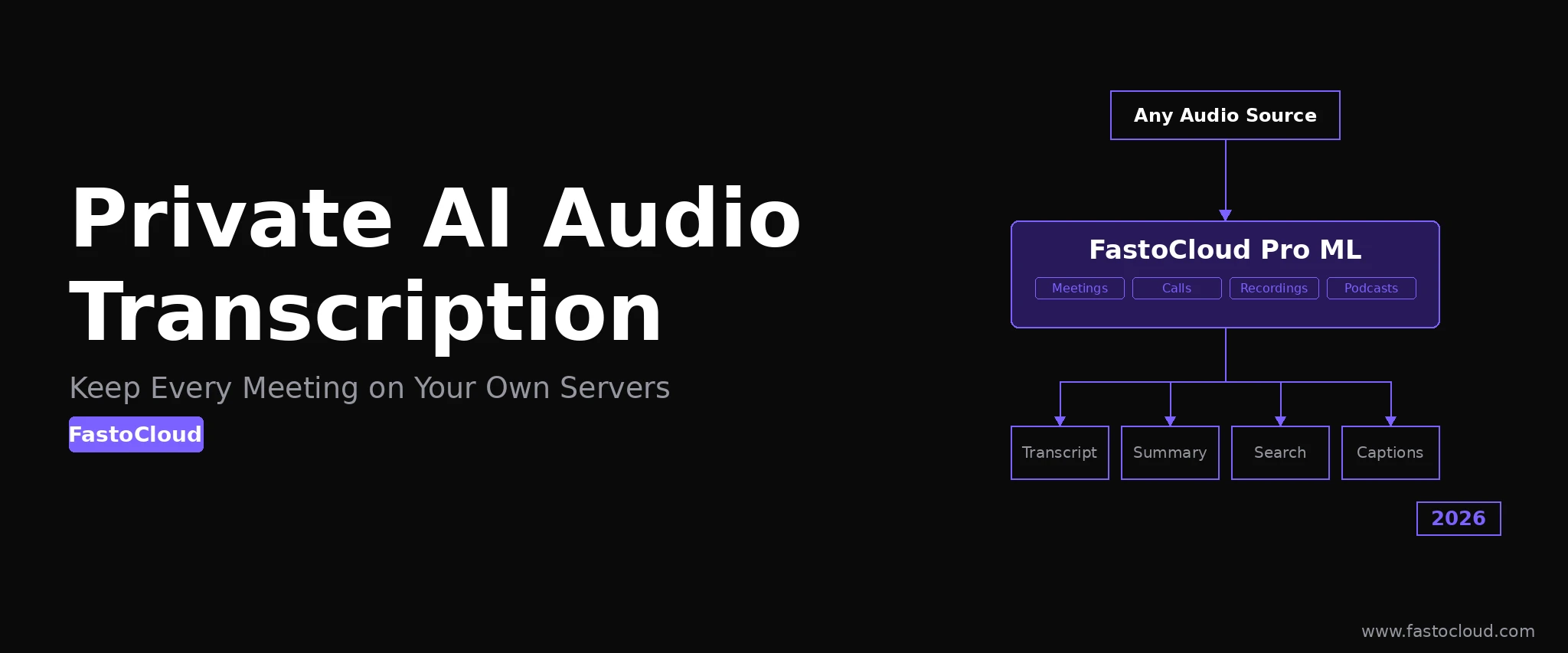
A common misconception is that transcription tools are narrow - one product for meetings, another for podcasts, another for call centres. A self-hosted engine collapses those into a single pipeline, because the same platform can accept effectively any audio you can point it at:
- Video meetings - internal stand-ups, client calls, and all-hands sessions turned into notes and action items.
- Phone and VoIP calls - sales and support conversations captured for review, coaching, and quality assurance.
- Recordings and archives - back-catalogues of webinars, interviews, and training sessions measured in hundreds of hours.
- Podcasts and long-form audio - full episodes transcribed for show notes, search, and accessibility captions.
- Field and event audio - conferences, panels, and on-site recordings that arrive in mixed formats and mixed languages.
Because there is no external vendor deciding which file types or use cases are allowed, multi-speaker conversations, hours-long recordings, and mixed-language audio all flow through the same system. One deployment covers both the live "take notes on this meeting" case and the bulk "transcribe our entire 2,000-hour archive" case, instead of paying for and integrating two separate tools.
Self-Hosted, and Flexible Because of It
The biggest practical advantage of running transcription yourself is not any single feature - it is flexibility. The engine can run in your data centre, on a server in your office, or on a machine in an isolated network with no internet access at all. For organisations that keep a local AI model inside their own infrastructure, transcription simply becomes another capability on hardware they already operate, alongside the rest of their private tooling. Nothing has to phone home, and nothing depends on an outside service staying online or keeping its pricing stable.
That flexibility extends to how the output is used. Because everything is generated internally, transcripts can feed directly into your own search, your own summarisation, and your own internal knowledge base without a round-trip to an external API for each step. The FastoCloud Pro ML edition is built for exactly this kind of AI workload on your own machines, and it sits inside the same complete FastoCloud platform that already handles media ingest, processing, and delivery - so transcription is an extension of infrastructure many teams have deployed, not a brand-new stack to learn.
Meetings: Google Meet and Beyond
Meetings are where most companies first feel the pain of cloud transcription, because the popular note-taking assistants join your call as an external guest and quietly ship the entire conversation to their own servers. FastoCloud is bringing the same private engine to meeting platforms, with a Google Meet plugin rolling out that captures meeting audio and turns it into a transcript, a summary, and searchable notes automatically - and all of it stays inside your own environment. The plugin slots into the meetings your team already runs, so there is nothing new for participants to install or approve on the call.
If you want to see the output quality before committing a server to it,
WhoSayAh
is our free public transcription tool - no account, no signup - and returns a
speaker-labelled transcript you can download as .txt or .vtt.
Running one of your own recordings through it is the quickest way to judge whether the
speaker labelling holds up on your material; there is a walkthrough for
recording and transcribing a Google Meet call
end to end.
The important shift is architectural: instead of a separate meeting-notes product with its own account, its own data-sharing terms, and its own subscription, a meeting simply becomes one more audio source feeding the private pipeline you already run for recordings and calls. The same transcripts, the same summaries, and the same search index cover live meetings and archived media alike. As additional platforms are added, the pattern stays identical - the audio changes source, the privacy guarantee does not.
The Cost Case: Flat vs Per-Minute
Privacy is the headline, but cost is what usually closes the decision. Cloud transcription is metered per audio minute, which means the bill grows in lock-step with how useful the tool becomes - the more you transcribe, the more you pay, forever. A self-hosted deployment inverts that: a flat monthly software cost on hardware you already run, with no per-minute charge and no egress fees. The table below shows the crossover for a mid-sized workload:
| Monthly audio volume | Cloud API (metered) | Self-hosted FastoCloud Pro | Data leaves your network? |
|---|---|---|---|
| 100 hours | ~$36 - $144 | Flat $50/month | No (self-hosted) |
| 500 hours | ~$180 - $720 | Flat $50/month | No (self-hosted) |
| 2,000 hours | ~$720 - $2,880 | Flat $50/month | No (self-hosted) |
| 10,000 hours | ~$3,600 - $14,400 | Flat $50/month + hardware | No (self-hosted) |
Cloud figures assume the typical $0.006 - $0.024 per-minute range for AI transcription APIs in 2026. The self-hosted column is the software cost; you supply the server, which for many organisations is capacity they already have. The pattern is clear: below roughly a few hundred hours a month a metered API can be cheaper and simpler, but past that point the flat model pulls decisively ahead - and it does so while keeping every second of audio inside your own network. Full edition pricing is on the pricing page.
Getting Started with FastoCloud Pro
Private transcription is not a research project - it is a deployment. FastoCloud Pro and Pro ML install on your own Linux servers and process audio locally, so the fastest way to evaluate it is against your real material: point it at a representative set of your meetings, calls, and archived recordings and compare the transcripts, summaries, and search results to whatever you use today. The free trial lets you run that comparison on your own hardware before committing, and the installable components are available from the downloads page.
The broader point is that transcription does not have to be a standalone SaaS subscription that leaks your conversations to a third party. It can be a private capability that lives beside the rest of your media and AI infrastructure. FastoCloud already powers self-hosted streaming, media processing, and OTT delivery for operators worldwide - including the CrocOTT platform for IPTV and OTT services - and private AI transcription extends that same self-hosted philosophy to the spoken word. Your meetings, your calls, your recordings, your servers - and now, your transcripts.
Blog FastoCloud